 Report
The vessel, which was typically stationed in Riga, was en route to a naval visit in Karlskrona.
Alert MRCC 001102 was issued to the search and rescue services.
The Coast Guard vessel Spulga ran aground for unknown reasons and became waterlogged. With the assistance of a helicopter, representatives from the Swedish Coast Guard and the Latvian Navy were lowered to the distressed vessel. Subsequently, the Coast Guard was able to remove 13 cubic meters of bunker oil from the ship. The oil was pumped into large bags and taken aboard one of the Coast Guard’s environmental protection vessels.
A few days after the grounding, representatives from the Latvian Navy and the Red Company decided to attempt to tow Spulga off the ground outside Utklippan. Shortly after the towing operation commenced with the help of the Coast Guard, the vessel developed a severe list and sank, three nautical miles northwest of Utklippan. The representatives from the Red Company and the Latvian Navy who were on board had to evacuate the ship in haste.
After the sinking (November 2, 2000) the location was marked with a red buoy, although the wreck does not pose any obstruction to navigation.
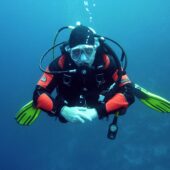
The vessel is nearly upright on the seabed at a depth of approximately 44 meters. It remains largely intact and offers much to observe, as it has not been long since it sank. The Coast Guard’s pumps are still located at the stern following attempts to salvage the vessel. Since she is situated on the “open” sea, the location can be quite sensitive to weather conditions and winds; it can also be rather turbulent on the way down. It is possible to seek shelter at the islet if the weather becomes particularly severe.
 Wind
Wind
 29 km/h
 Swell
Swell
 Height
 Rain, Partially cloudy
 --
--
 17°C
17°C